
 EN
EN

Catadioptric Reflection: Refraction, Total Internal Reflection, and Refractive Index Matching
Catadioptric reflection is the foundational optical mechanism behind retroreflection. It combines refraction and total internal reflection to steer light back toward its source. When a light ray enters a retroreflective element—such as a glass bead—it slows and bends due to the change in medium density, a phenomenon known as refraction. This bending directs the light toward the rear surface of the optic. Precise refractive index matching between the bead and its surrounding medium ensures minimal transmission or absorption and enables efficient total internal reflection. The light then refracts again upon exiting, returning along a path parallel to its original incidence. Unlike simple mirror (specular) reflection, this process actively corrects trajectory using spherical or prismatic geometry. Its performance is quantified by the coefficient of retroreflection (RA), expressed in cd/lux/m²—the standard metric for measuring how effectively light is returned to the illuminator.
Retroreflection vs. Diffuse and Specular Reflection: A Fundamental Distinction
Retroreflection differs fundamentally from both specular and diffuse reflection. Specular reflection follows the law of reflection: light bounces at an angle equal and opposite to its incidence—so visibility depends strictly on observer position relative to the light source. Diffuse reflection scatters light broadly across many angles, producing uniform but low-intensity return; it creates matte appearance but delivers negligible light back to the source. In contrast, retroreflection is engineered to concentrate light into a narrow cone directed back toward the illuminator, regardless of entrance angle—within defined angular limits. This results in high brightness contrast for observers near the light source (e.g., drivers), while remaining relatively inconspicuous to others. That directional intensity boost is what makes retroreflective materials uniquely effective for safety applications where detection distance and recognition speed are critical.
Retroreflection Science: Glass Bead vs. Microprismatic Technologies
Glass Bead Retroreflection: Embedding, Refractive Index Constraints, and Angular Limitations
Glass bead retroreflection relies on thousands of microscopic spherical lenses embedded in a binder layer. Light entering a bead refracts at the front surface, focuses onto a reflective backing (typically aluminum or silver-coated), reflects, and refracts again upon exit—returning toward the source. Efficiency hinges on precise refractive index matching between the bead (typically ~1.5–1.9) and embedding depth to ensure the focal point lands accurately on the reflective layer. Photometric efficiency is inherently limited: even optimized systems achieve only ~28% light return. Performance also degrades significantly at wider entrance angles—making them most effective when headlights strike nearly perpendicularly. Wet conditions further reduce efficacy in exposed-bead designs, as water disrupts the critical air-glass interface. Encapsulated versions preserve an air gap, restoring optimal refraction and delivering superior wet-weather performance.
Microprismatic Retroreflection: Precision Arrays and Higher Photometric Efficiency (Rₐ)
Microprismatic technology uses precisely aligned cube-corner prisms—each composed of three mutually perpendicular reflective faces—to achieve retroreflection via total internal reflection. This geometric design eliminates reliance on refractive index matching and delivers higher photometric efficiency than glass beads. High-performance microprismatic materials achieve Coefficient of Luminous Intensity (CIL) values exceeding 500 cd/lux/m², compared to 200–300 for premium glass bead tapes—translating directly to greater detection distances. Because reflection occurs internally within solid acrylic or polycarbonate, microprismatic structures resist UV degradation and retain reflectivity through repeated cleaning and abrasion. Crucially, their angular performance is broader: they maintain high RA across wider entrance and observation angles, making them especially suited for dynamic environments like highways and emergency response zones where body movement and variable lighting angles are common.
Retroreflection Science in Action: Real-World Hi-Vis Safety Performance
ANSI/ISEA 107 Compliance: Striping Design, Placement, and Angular Return Optimization
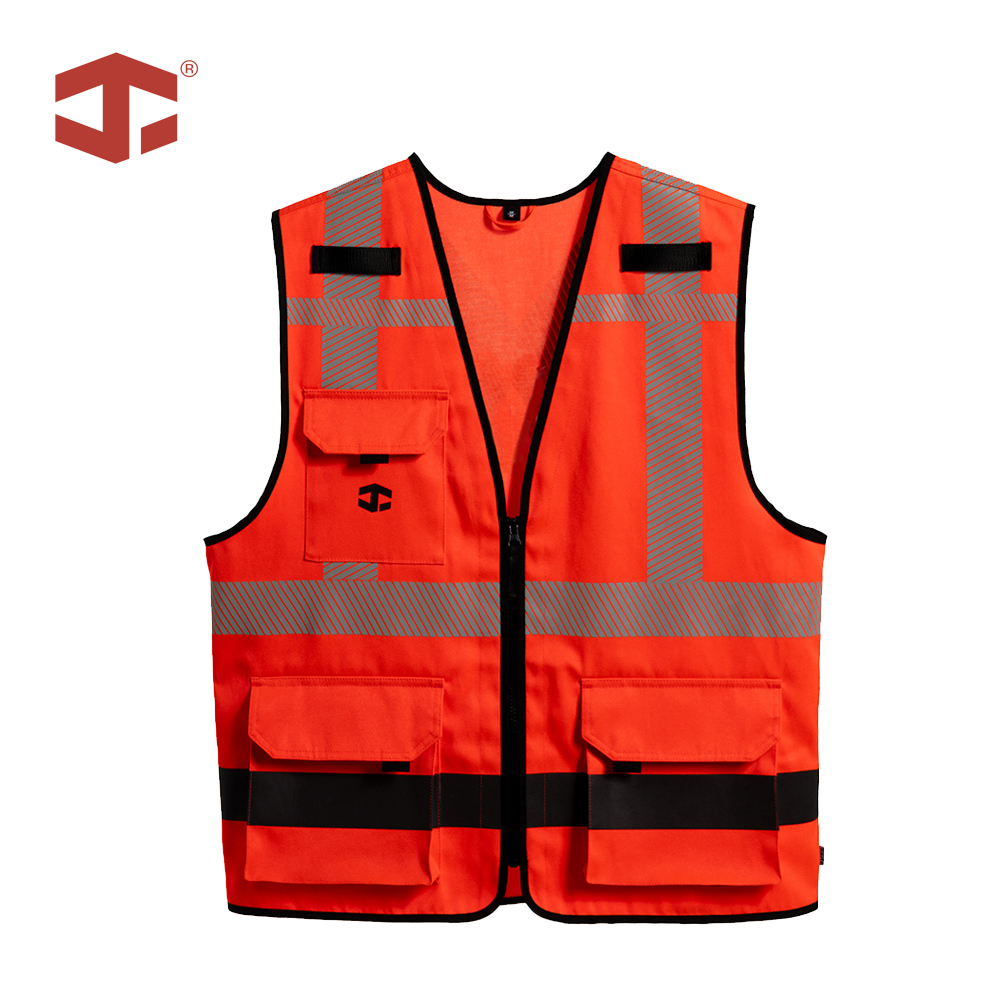
Retroreflection science underpins the striping requirements of ANSI/ISEA 107—the U.S. standard for high-visibility safety apparel. The standard defines three performance classes based on risk environment: Class 1 (low-speed, <25 mph), Class 2 (moderate-risk, e.g., roadside work), and Class 3 (high-speed, >50 mph). Each mandates minimum retroreflective tape area, width, and strategic placement—such as 360° bands around arms and torso—to outline the human form and support rapid recognition. Angular return optimization is essential: vehicle headlights rarely strike tape at 0°, so materials must sustain high RA across real-world entrance angles (up to ±30°) and observation angles (±20°). Microprismatic tapes excel here, maintaining strong return even when wearers bend, turn, or move laterally—ensuring consistent conspicuity without requiring perfect posture or alignment.
Fluorescence + Retroreflection: Dual-Mechanism Visibility Across Lighting Conditions
True all-day conspicuity requires two complementary optical mechanisms: fluorescence for daylight and twilight, and retroreflection for nighttime. Fluorescent background materials absorb ultraviolet (UV) radiation—abundant even on overcast days—and re-emit it as visible light, enhancing chromatic contrast against typical surroundings. This effect peaks when ambient visible light is low but UV remains present, such as during dawn, dusk, or shaded conditions. At night, retroreflection takes over, returning headlight illumination directly to the driver’s eyes. The World Health Organization identifies poor visibility as a key contributor to road traffic injuries—the leading cause of death among people aged 5–29. ANSI/ISEA 107 explicitly requires both mechanisms: strict luminance and chromaticity thresholds for fluorescent backgrounds and minimum RA values for retroreflective tape. This dual-mechanism framework ensures garments perform reliably across the full spectrum of lighting conditions—leveraging fluorescence’s broad-spectrum energy conversion and retroreflection’s targeted, high-intensity return.